An afternoon in the Oltrarno: what Florence's artisan workshops are actually like
An afternoon spent tracking down working artisan studios in the Oltrarno — leatherworkers, a gilder, a paper marbler — and what it’s actually like to watch them work.
| Where | Oltrarno, south bank around Piazza Santo Spirito |
| Time needed | A half-day, ideally a weekday afternoon |
| Cost | Free to walk and look; pieces from around €8 (marbled paper) to €600 (gilded frames) |
| Getting there | On foot from the Ponte Vecchio or Ponte Santa Trinita |
| Best time | Tuesday–Thursday mornings, when workshops are most active |
Why the Oltrarno is where Florentine craft survived
The Oltrarno — literally “beyond the Arno,” the south bank of the river — has been the working quarter of Florence since the medieval period. While the north bank accumulated the major religious buildings, the banks, the guild halls, and eventually the major museums, the south bank accumulated the workshops. Goldsmiths, woodworkers, leatherworkers, gilders, stonemasons, restorers: the people who made and fixed things. The people whose skills supported the economy of beauty that Florence has always run on.
Those workshops are still there. Not as many as there used to be — rents have risen, successors are hard to find, some crafts have died out or contracted to a handful of practitioners — but enough that an afternoon in the Oltrarno on a weekday can take you past functioning studios where the same work has been happening in the same space for three or four generations.
This is the story of one such afternoon.
Starting in Piazza Santo Spirito
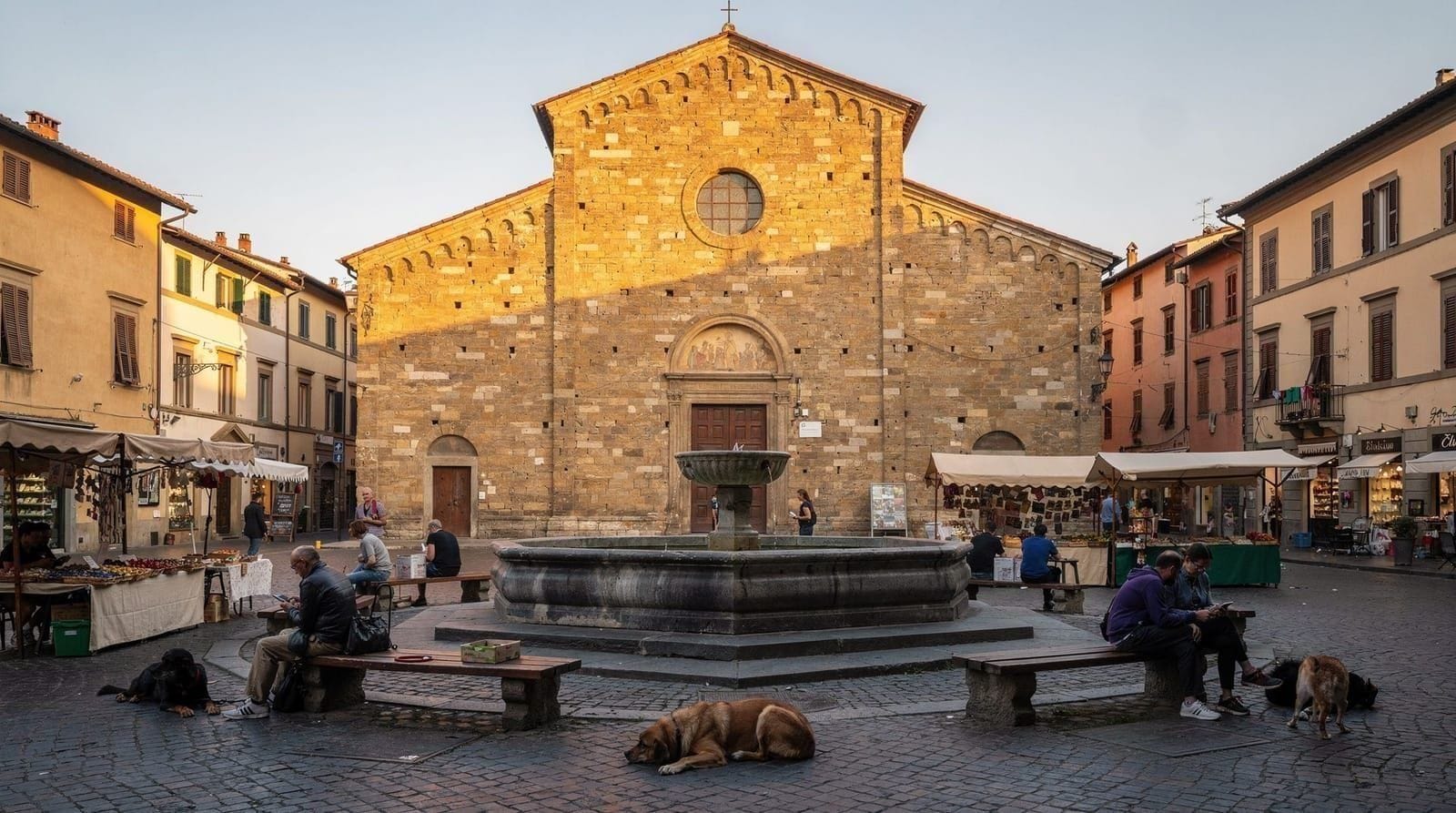
The obvious starting point is the Piazza Santo Spirito, the square in front of Brunelleschi’s unfinished masterpiece. On a Tuesday afternoon in March it was busy but not overwhelmed — a small market in the middle, a few people sitting on the steps of the church, the café tables at Bar Ricchi half-occupied.
The Oltrarno walking tour guide suggests the streets immediately east and west of the piazza as the primary artisan zones. West takes you toward the Borgo San Frediano, which has more residential character and the occasional working studio hidden behind unmarked doors. East takes you toward Via Maggio — a long straight street of antique dealers and their back-room restorers, where you can walk past windows full of 17th-century furniture being stripped and re-waxed by people who look at you with polite indifference if you peer in.
I went east, then south toward the Arno.
The leatherworkers of the Oltrarno
The Florentine leather tradition guide covers the history: Florence has been a leather city since the medieval period, when the Arte dei Calimala (the wool merchants’ guild) also controlled the leather trade. The Franciscan friars at Santa Croce began teaching leatherworking to disadvantaged young men in the 1950s, founding the Scuola del Cuoio (School of Leather) that still operates behind the basilica today.
The Oltrarno version of this tradition is less institutionalized and harder to find. There are no signs advertising workshops in the way that the market stalls around San Lorenzo advertise “100% genuine Italian leather” (a claim worth interrogating carefully — much of the San Lorenzo market merchandise is neither 100% leather nor made in Italy, despite the advertising).
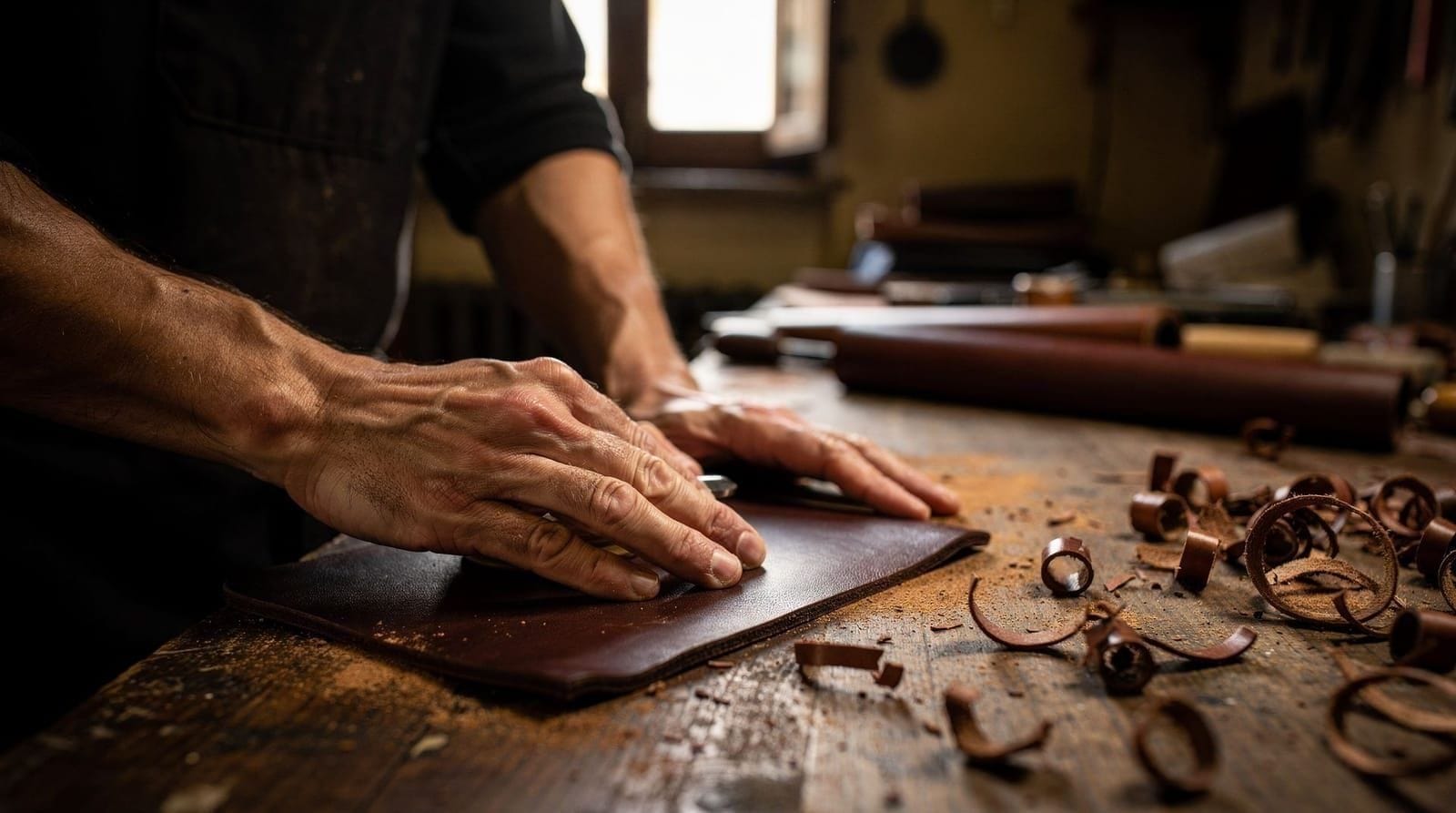
The real Oltrarno leatherworkers tend to occupy ground-floor spaces on the minor streets: Sdrucciolo dei Pitti, Via dello Sprone, the smaller lanes running perpendicular to Borgo San Jacopo. I found three working studios in an afternoon, which was not systematic — I found them by following the smell of tannin and leather and the sound of cutting tools on a chopping board.
The first was a small atelier that made and sold bags and belts. A woman in her forties was working at a table near the window, cutting a pattern from a piece of vegetable-tanned calf leather. She didn’t look up when I pushed the door open, then did look up, assessed me as harmless, and returned to cutting. There was a small display near the door with finished pieces: belts at €60–90, wallets at €45–70, small bags at €120–200. The prices were honest — not cheap, but considerably less than the equivalent quality from a brand-name leather goods house.
She answered a few questions in minimal English and considerable Italian. The leather, she said, came from a tannery in Córdoba. The vegetable tanning — the slower, more expensive process that produces more durable leather than the chrome tanning used in most mass production — gave it its particular colour and texture. It would last, she said, waving at the piece she was working, probably thirty years. More if you waxed it.
A gilder on Via dei Serragli
I spent probably fifteen minutes too long in the leather shop and had to move. Via dei Serragli runs north-south through the middle of the Oltrarno and has a mix of residential buildings, bars, and — tucked between them — some of the more unusual workshops. A furniture restorer’s studio that opened directly onto the pavement. A framer whose window displayed work that suggested he had opinions about framing that most framers don’t share. And a gilder.
Gilding — applying gold leaf to frames, furniture, and decorative objects — is one of the Florentine crafts that has contracted most dramatically in the past fifty years. The skills are complex, the materials are expensive (genuine gold leaf runs €5–8 per sheet, with a frame requiring dozens of sheets), and the market for high-quality gilt frames is smaller than it was when every palazzo and church was being decorated.
The studio on Via dei Serragli was tiny: one room, one man, a workbench covered in the detritus of his trade. He was applying burnishing clay (bolo) to a frame with a soft brush, the first of several preparatory layers before the gold goes on. He was happy to be watched and not opposed to being asked questions, though his English was limited to the professional vocabulary.
What the gilder explained, through a combination of gesture and my approximate Italian: the gold leaf was genuine 24-carat, beaten to a thickness of 0.0001 millimetres. The application requires a specific brush, a specific humidity, and the breath held at the critical moment when the leaf transfers from the brush to the surface. A frame of the size he was working — maybe 60 × 45 centimetres — would take two to three days to complete properly. He charged €300–600 for work like this. He was not in a hurry.
Carta marmorizzata: the paper marblers
The last stop was on the Lungarno Guicciardini, the road along the south bank of the Arno. Paper marbling — carta marmorizzata — is another Florentine craft tradition, originally developed in the Ottoman Empire and adopted in Europe through Venice and then Florence in the 16th and 17th centuries. The paper was used for endpapers in books and for decorative stationery; the tradition nearly disappeared but has been revived by a handful of specialized studios.
The one I visited was a combination studio and shop. In the back, a woman was working at a tank of size (a viscous solution of carrageenan seaweed) on which she was dripping paint and combing patterns before laying paper on the surface and lifting the image. The patterns at this level of skill are precise and complex — not the casual swirls you can achieve at a tourist demonstration, but geometric Turkish patterns (ebru) and Italian combed patterns (peigné) with hundreds of fine lines running parallel across the surface.
The finished paper in the shop ran €8–25 per sheet, with books and journals made from marbled paper at €30–80. These are not cheap. They are also, genuinely, beautiful things made by skilled people using techniques that have been in continuous use for five hundred years.
She explained, in good English, that she had learned the craft from a Venetian master. The tradition in Florence, she said, was slightly different from the Venetian version — the size was prepared differently, the pigments used were different, the pattern traditions diverged. Asked how long it took to become competent, she thought for a moment: five years to make reliably good paper, she said. Twenty to understand what you’re doing.
What this kind of tourism actually means
There’s a version of the Oltrarno artisan experience that is packaged for tourists: workshops that do demonstrations, that sell souvenir leather bracelets and marbled postcards, that charge €50 for a two-hour leather stamping session. Some of these are fine; they serve a purpose.
What I’m describing is different: the studios where people work, where what they’re making is the point and the visitor is an occasional interruption rather than the primary product. These places don’t advertise. They’re hard to find on purpose — not deliberately hidden, but not announced either.
The Oltrarno neighbourhood guide and the Santo Spirito guide have some starting points. The best approach is to walk the streets between Piazza Santo Spirito and the Arno on a Tuesday, Wednesday, or Thursday morning — when the workshops are most active — and follow what’s interesting. Look for open doors, listen for tools, peer into ground-floor windows.
For a structured introduction, the leather crafting experience workshops in the Oltrarno offer two to three hours working alongside a Florentine leather artisan making a piece you take home. These are significantly more genuine than the San Lorenzo market leather-stamping operations. The Florentine leather tradition guide covers the workshop options and what to look for.
Where to eat in the Oltrarno before or after
The where to eat in Oltrarno guide is your resource here. The short version: Buca Mario for a special occasion meal (the oldest restaurant in Florence, founded 1886, though now under corporate management that divides opinion). Il Guscio on Via dell’Orto for reliable neighbourhood trattoria food without tourist-menu theatrics. Trattoria del Carmine for ribollita on Mondays. The bar at Piazza Santo Spirito for a standing aperitivo between 6 and 8 p.m. with the neighbourhood’s residents.
The Oltrarno rewards the unhurried. Give it an afternoon, ideally on a weekday when the studios are working, and walk slowly. The things that make Florence irreplaceable are not only in the museums.
Comparing the three crafts
If you only have time to seek out one or two studios, here’s how the three I visited compare, to help decide where to spend your afternoon.
| Craft | Typical price | Time to make one piece | Easiest to find |
|---|---|---|---|
| Leatherwork | €45–200 (wallets, bags, belts) | Hours to a few days | Yes — several studios near Sdrucciolo dei Pitti |
| Gilding | €300–600 (a frame) | 2–3 days per frame | No — tiny, unmarked studios, ask locals |
| Paper marbling (carta marmorizzata) | €8–80 (sheets to journals) | Minutes per sheet, years to master | Moderate — a few combined studio-shops on the Lungarno |
Leatherwork is the easiest entry point if you want a souvenir and a genuine glimpse of the craft in one stop. Gilding is the hardest to find but the most mesmerising to watch, if you stumble on an open door. Paper marbling sits in the middle — accessible, photogenic, and the studios are usually happy to explain the process even if you’re not buying.
Practical tips for visiting artisan workshops respectfully
These are working spaces, not tourist attractions, and a little etiquette goes a long way. Knock or wait at the threshold rather than walking straight to the workbench — most artisans are welcoming once they’ve clocked you’re interested rather than just browsing. Don’t touch tools or materials without asking. If you want photographs, ask first; some are happy, others would rather you didn’t, especially mid-process when concentration matters. Buying something, even something small, is appreciated and helps these studios survive rising Oltrarno rents. And don’t expect fluent English — a smile, patience, and basic Italian numbers for prices go a long way.
For a guided version of this experience rather than wandering solo, the leather crafting workshops mentioned above give you two to three hours with an artisan and a finished piece to take home, which suits travellers short on time or nervous about knocking on unmarked doors.
Frequently asked questions about Oltrarno artisan workshops
Do I need to speak Italian to visit these workshops? No, though a little goes a long way. Some artisans, like the paper marbler on the Lungarno Guicciardini, speak good English; others communicate mainly through gesture and patience. Basic courtesy — a greeting, please and thank you in Italian — is appreciated even when the rest of the conversation happens in English or sign language.
Can I buy directly from the artisans, and do they ship internationally? Most sell directly from their studios, and prices are usually marked or quoted on request. Shipping varies by workshop — some smaller studios don’t offer it at all, so if you’re buying something larger like a gilded frame, ask about shipping before committing, or plan to carry it home.
Top experiences
Bookable activities with verified prices and instant confirmation on GetYourGuide.