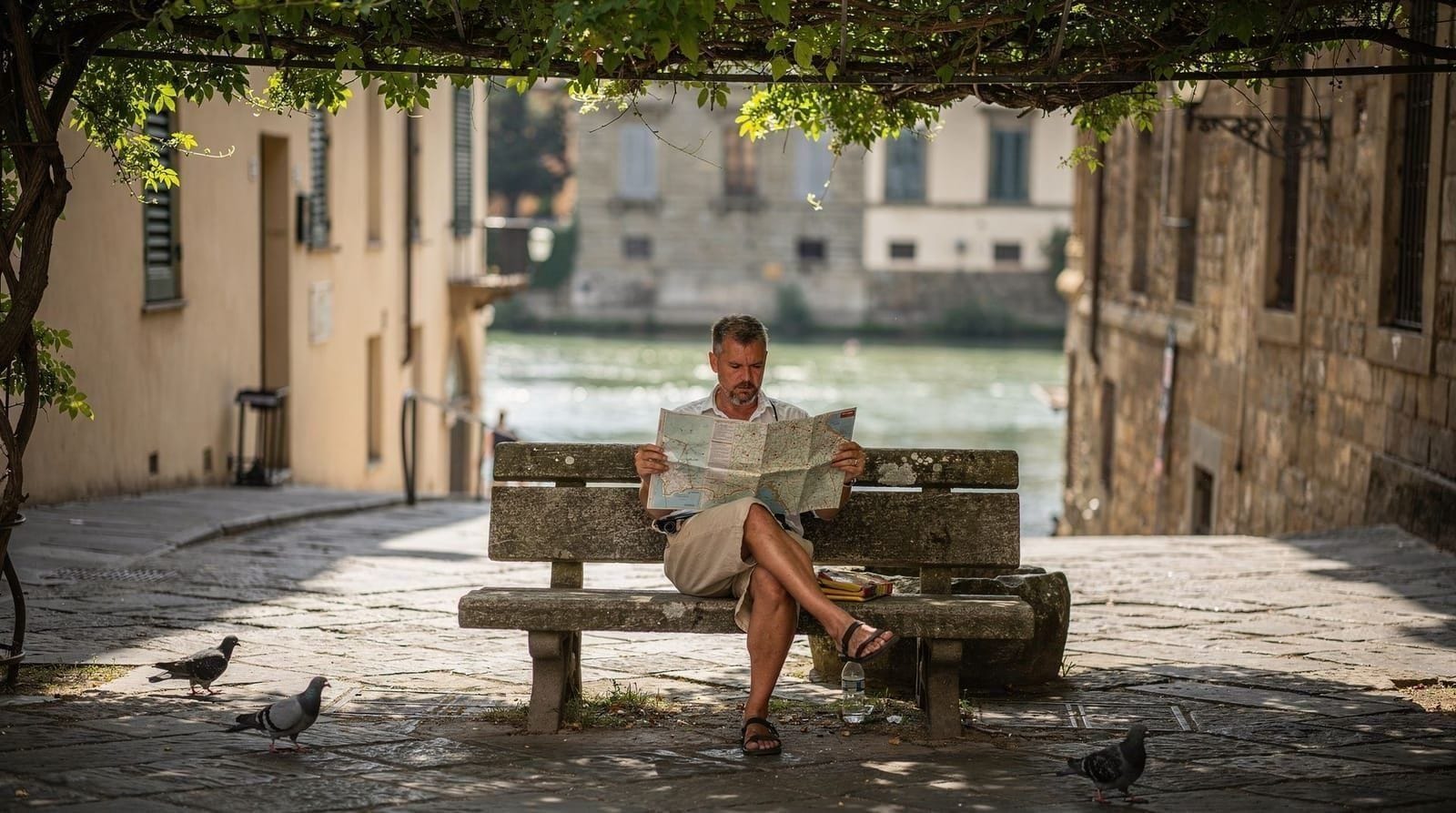
My first morning in Florence changed everything
A first morning in Florence doesn’t need a plan — it needs an early alarm and a willingness to get a little lost. Here’s the shape of the one that changed how I travel, plus the practical details if you want to try it yourself.
| Where | Ponte Vecchio, Duomo, Oltrarno, Piazzale Michelangelo |
| Time needed | A full morning, roughly 5:30am–11am |
| Cost | Free to walk; coffee and a cornetto around €2–4 at a bar counter |
| Getting there | On foot from any central hotel — Florence’s historic centre is compact |
| Best time | Sunrise, ideally April–June or September for mild, quiet mornings |
The alarm went off at 5:30 and I nearly ignored it
I had flown in from Edinburgh the previous evening, taken the bus from Pisa airport across the darkening plain of Tuscany, and arrived at my B&B on Via dei Servi at nearly midnight. The room had terracotta tiles and a single window that opened onto a narrow street. I could hear a cat. I fell asleep almost immediately.
The alarm was set for 5:30 because a friend who had been to Florence three times had given me exactly one piece of advice: “Go to the Ponte Vecchio before 7 a.m. You’ll understand.”
I did not understand yet. I buried the phone under the pillow, then lay there for four minutes thinking about it, then got up.
What the Ponte Vecchio looks like at 6 a.m.
The city at that hour is not empty — it never quite is — but it is quiet in a way that feels unearned, like finding a room in a museum after closing time. The street sweepers were working in the Piazza della Repubblica. A man on a bicycle crossed the Arno on the Ponte alle Grazie. The sky was the particular pale grey of early September in central Italy, the kind that promises warmth later but holds it in reserve.
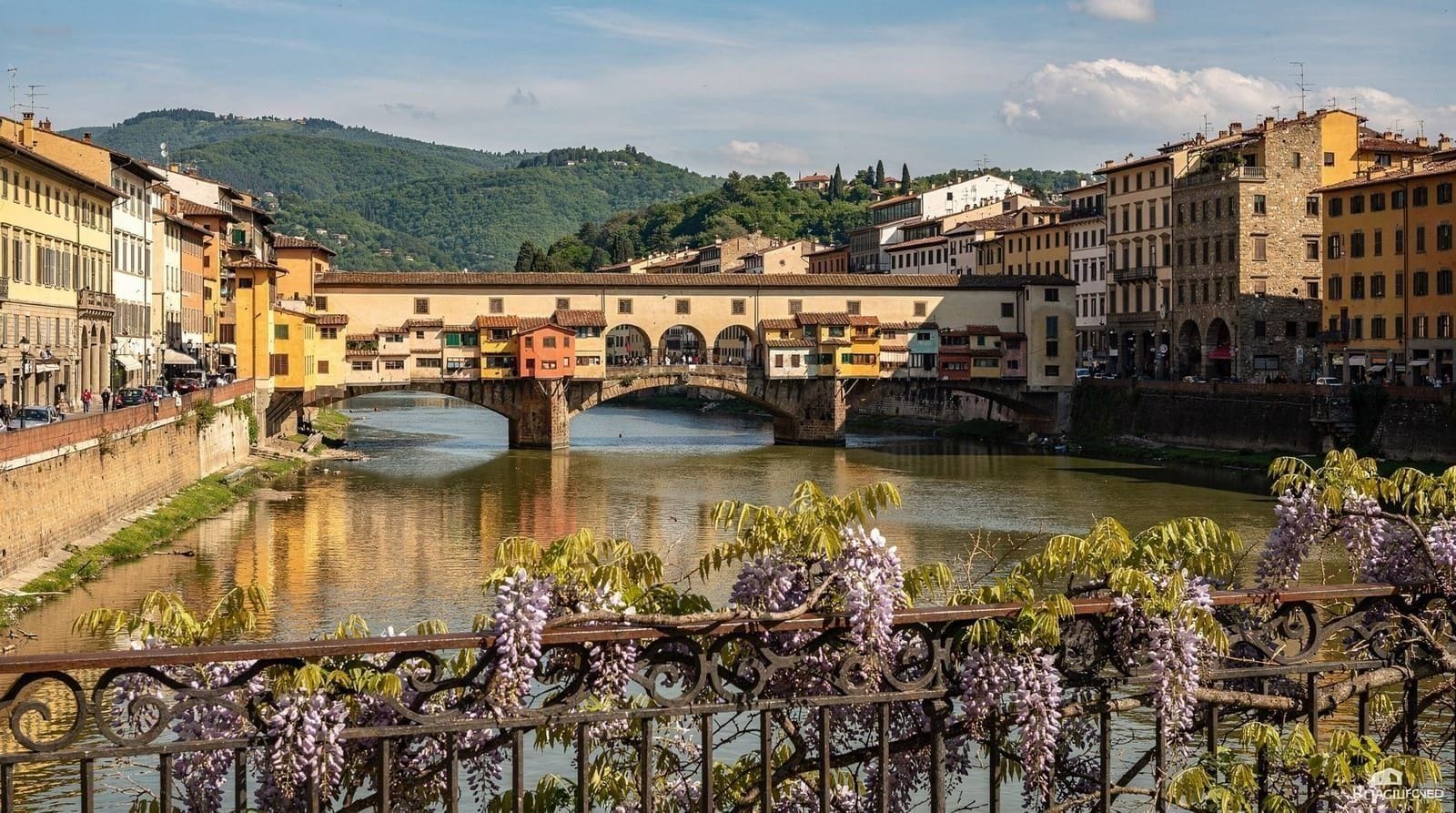
I walked south from Via dei Servi, turned by the Bargello, and came out onto the Lungarno — the road that runs along the river — without planning to. The Ponte Vecchio was ahead, its medieval shops still shuttered, the gold of the jewellers hidden behind green wooden panels. In the middle of the bridge I stopped and looked east, upriver, toward the low hills beginning to catch the light. The water was very still. A pigeon landed on the parapet and regarded me without interest.
I stood there for probably ten minutes doing nothing useful, and I think I understood what my friend had meant.
Getting lost near the Duomo (the good kind)
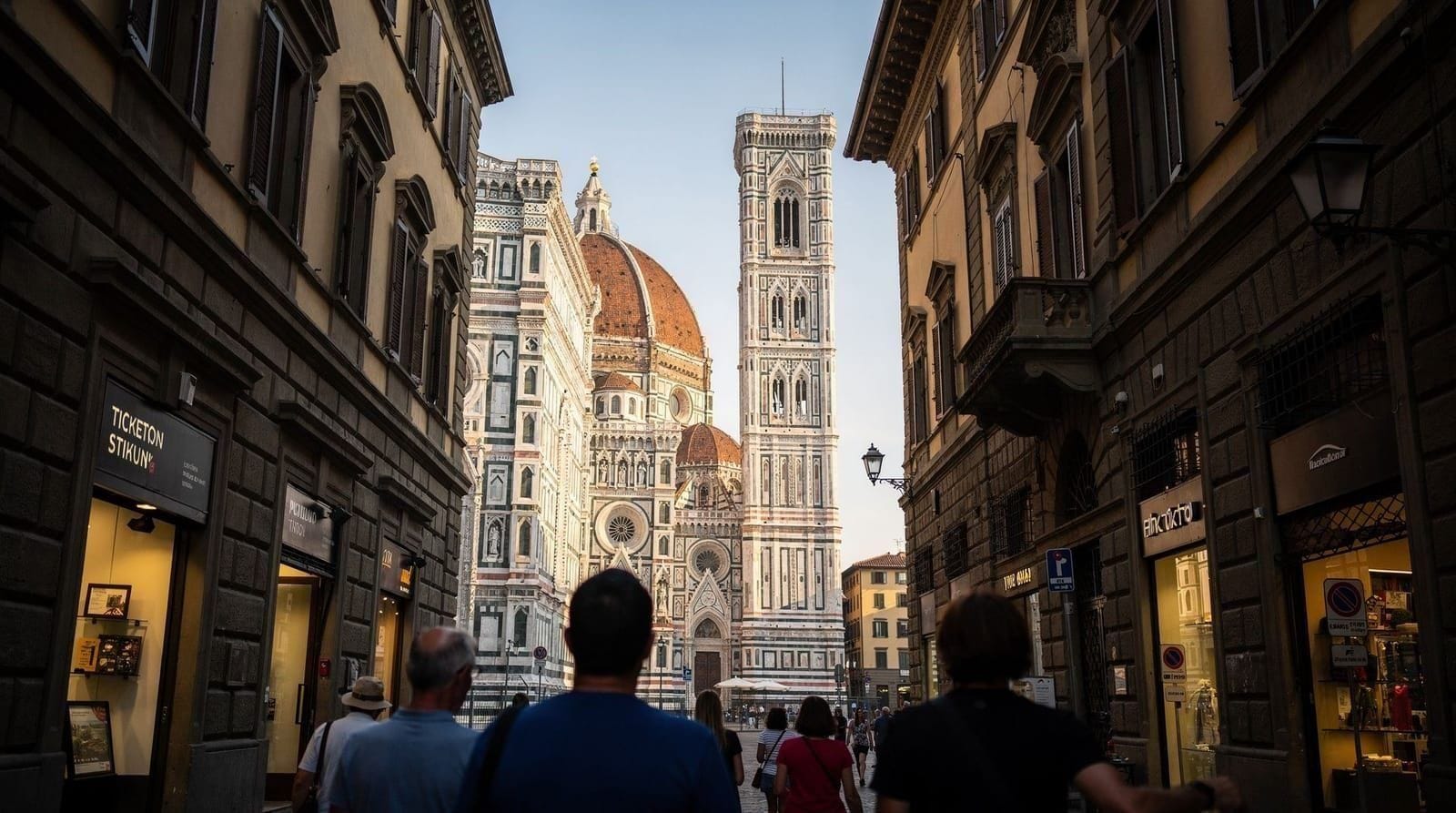
My plan for the first morning — such as it was — involved finding the Duomo and standing in front of it. This is an eminently achievable plan in Florence; the dome is visible from almost everywhere and you can navigate to it by simply walking toward the part of the sky where something enormous seems to be happening.
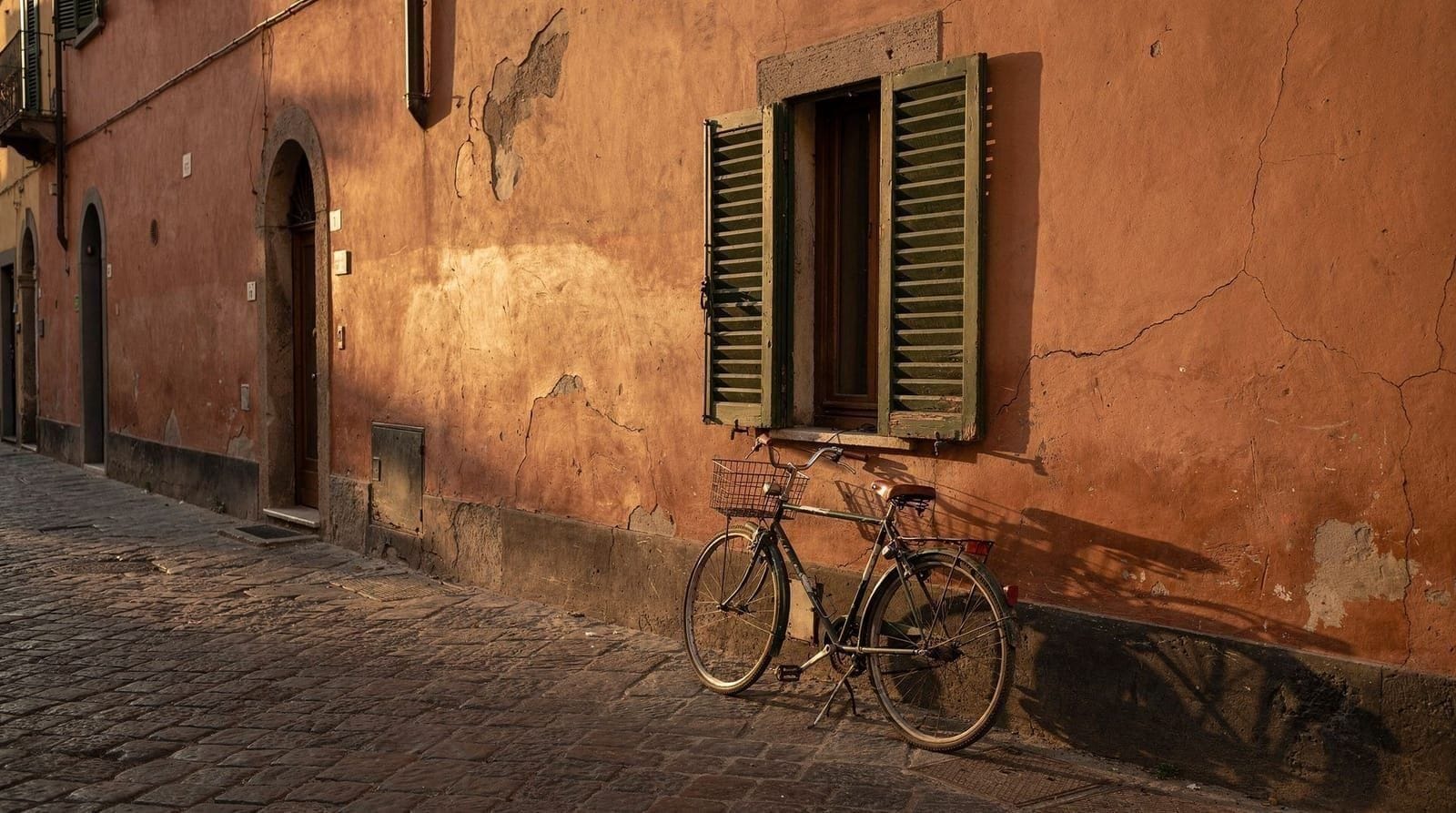
What I hadn’t planned for was getting pleasurably lost in the streets around it. Florence’s medieval street grid was laid down before anyone worried about making it navigable, and the lanes between the Bargello and the Duomo are a maze of irregular widths and unexpected dead ends. I turned a corner expecting a piazza and found a tiny church I’d never heard of. I turned another and found myself in a cobbled street barely wide enough for two people, with laundry strung overhead and the smell of bread from somewhere I couldn’t locate.
When the Duomo finally appeared — around a corner, filling a piazza that felt too small for it — the scale was genuinely shocking. I had seen photographs. I had known it was large. I had not understood that standing in front of Brunelleschi’s dome would make my sense of perspective briefly malfunction, the way it does when you’re not quite sure how far away something is.
I sat on the steps of the Baptistery for twenty minutes and watched the city begin its day.
Coffee and the ritual of the bar counter
By 7:30 I was hungry in the unfocused way of the jet-lagged, and slightly cold. I found a bar — a Florentine bar, which means a standing café, not a place that serves alcohol — on a side street near the Piazza della Signoria. There were three men in work clothes at the counter having arguments about something I didn’t catch. A television on the wall was showing sports results. The barista moved behind the espresso machine with the focused efficiency of someone who has performed the same motion ten thousand times.
I ordered a caffè — just “caffè,” singular, because in Florence that means espresso — and a cornetto, the soft Italian croissant that comes plain or filled with apricot jam or custard. I ate standing up, as everyone else was doing, and paid €2.10, as the prices on the wall indicated. The espresso was very small and very good and gone in two sips.
This is Florence’s morning. Not the piazzas and the museums — those come later. The morning is this: a counter, a crowd of regulars, something to eat, and coffee that arrives in a cup the size of a shot glass and tastes better than anything that has ever come out of a large machine.
The Oltrarno on foot
After coffee I crossed the river by a different bridge — the Ponte Santa Trinita, elegantly rebuilt after German demolition in 1944 — and found myself in the Oltrarno. The south bank is a different city from the one the tourists mostly see. The streets are wider and more residential. There are fewer souvenir shops and more places that sell things people actually use: a hardware store with beautiful copper handles in the window, a pharmacy that has been in the same family for four generations, a workshop where a man was doing something to a piece of furniture with a drawknife.
The Santo Spirito neighbourhood was beginning to wake up. The piazza was being set up for a market that would open later. A woman was sweeping outside her door. The Basilica di Santo Spirito — Brunelleschi again, working with a purity of form he didn’t always achieve on other projects — was open, and I went in and had it nearly to myself.
This is the part of Florence that doesn’t appear much in the highlight reels. It’s the part I keep going back for.
Piazzale Michelangelo by mid-morning
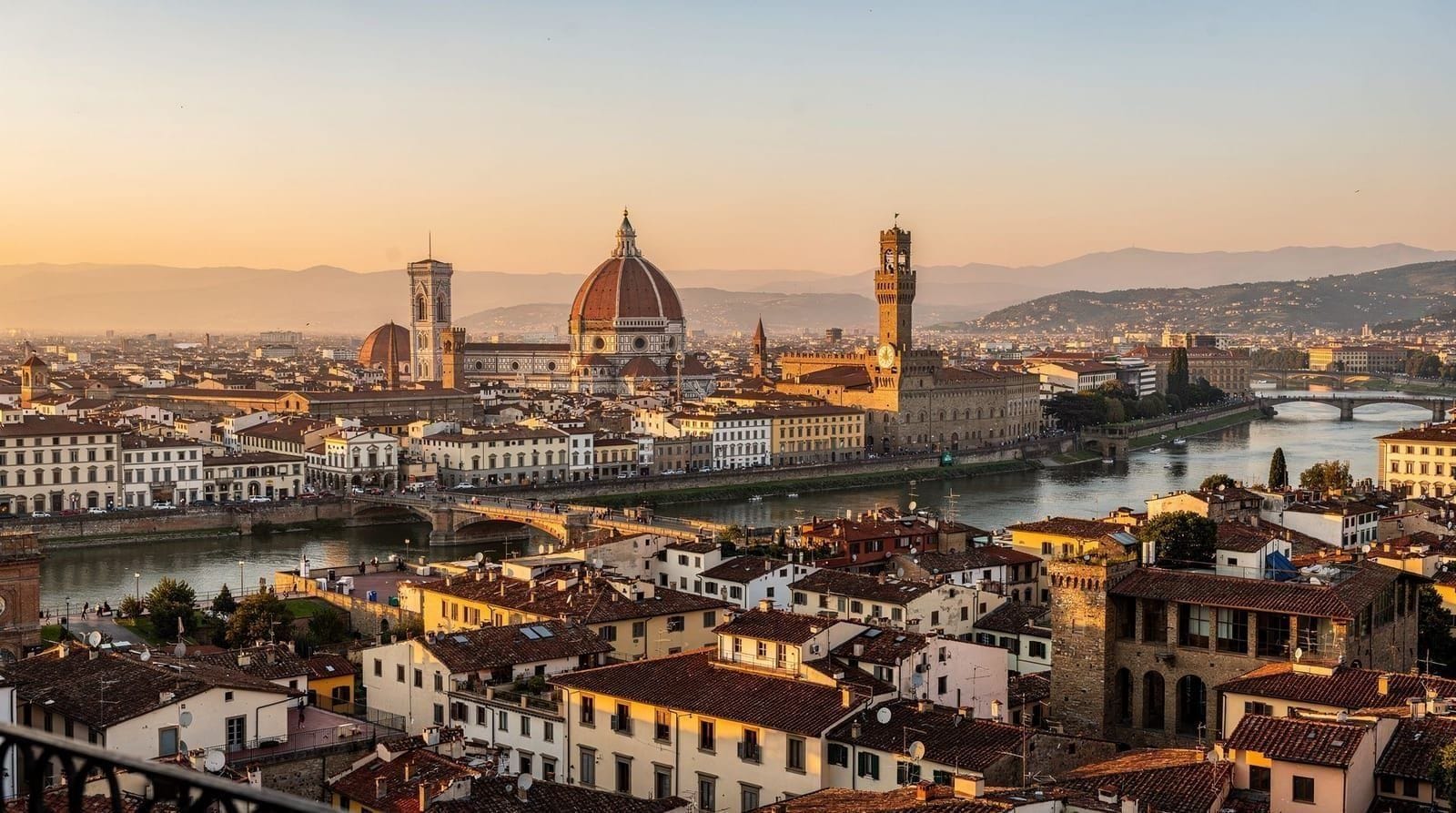
I climbed to Piazzale Michelangelo by the steps from the Oltrarno rather than the road, a route that passes through a small park and arrives at the viewpoint from the side rather than the front. By 10 a.m. the tour coaches were arriving and the terrace was getting busy, but the view was doing what it always does regardless: the dome dominant and copper-red at the centre, the Arno a silver line through the middle of everything, the city stretching away to the hills of Fiesole in the north.
I’m not an easy crier. But standing there, tired and caffeinated and slightly overwhelmed, I had the very strong feeling that I had arrived somewhere I was going to need to return to.
I’ve been back four times since.
Practical notes for your own first morning
If this sounds appealing — the early start, the empty bridges, the standing espresso — here’s the logistics of how to do it without thinking too hard.
Stay as central as you can. The city is compact, but at 5:30 a.m. you don’t want to be navigating from outside the historic centre. The neighbourhoods around Via dei Servi (between the Duomo and the Accademia), Santo Spirito in the Oltrarno, and the streets around Piazza della Repubblica are all good bases.
Eat breakfast at a bar counter. The big café-restaurants on the main piazzas charge two to three times what the neighbourhood bars charge for the same espresso and cornetto. Find a side street, look for a place where locals are standing, and go in.
Walk everywhere. Florence’s historic centre is so compact that taking a taxi or bus is almost never necessary once you’re inside it. The getting around Florence guide covers everything from the tram from the airport to the best routes between neighbourhoods.
Book the big museums in advance for later in the day. Your first morning should be free — the Ponte Vecchio at sunrise, the streets around the Duomo, the Oltrarno, a climb to Piazzale Michelangelo. Save the Uffizi and the Accademia for when you’ve oriented yourself and had a proper lunch. The how to book Uffizi tickets guide covers the booking process in detail.
Return at least once. One visit to Florence is not enough. It is never enough. The city releases itself slowly, and the things that matter most — the neighbourhood bars, the overlooked churches, the twenty-minute conversations with people who have been running the same shop for forty years — take time to find.
My friend was right. I went to the Ponte Vecchio before 7 a.m., and I understood.
What to do on day two (and beyond)
Once the first morning has done its work, you’ll have a better sense of what kind of traveller you are in Florence: a museum-goer, a walker, a food person, a combination of all three. The how many days in Florence guide helps structure the rest of your trip around your actual interests rather than a generic itinerary.
For a first full day, the combination of the Uffizi or Accademia in the morning (pre-booked, always pre-booked), lunch at the Mercato Centrale or in a trattoria in the Sant’Ambrogio area, the Oltrarno in the afternoon, and Piazzale Michelangelo at sunset is unbeatable and genuinely manageable without feeling rushed.
The city will give you more the more you give it. That’s the deal with Florence. It’s been keeping its end of the bargain for seven hundred years.
When to try this yourself
The early-morning version of Florence changes with the season, and it’s worth knowing what you’re walking into before you set an alarm for 5:30.
| Season | What the early morning is like | Trade-off |
|---|---|---|
| Spring (Apr–Jun) | Mild, soft light, wisteria in the Oltrarno gardens | Days warming up fast; book museums early |
| Summer (Jul–Aug) | Warm even at dawn, but still the quietest hour by far | Heat builds quickly after 9am |
| Autumn (Sep–Oct) | Cool, golden light, my personal favourite | Shorter window before crowds arrive |
| Winter (Nov–Mar) | Genuinely empty streets, cold air, dramatic light | Some bars open later; dress warm |
If you can only pick one window, September mornings are close to perfect: cool enough to walk briskly, warm enough by mid-morning for a coffee outside. The best time to visit Florence guide and the season-by-season breakdowns, like Florence in spring, go into more depth on what each month actually feels like beyond this one morning.
Where to base yourself for an early start
Where you sleep matters more than people expect when the plan involves a 5:30am alarm. I was lucky with Via dei Servi, a few minutes on foot from both the Duomo and the Accademia. If you’re choosing for the first time, the where to stay in Florence guide and the best areas to stay guide cover the trade-offs between the historic centre, the quieter Oltrarno, and the area around Santa Maria Novella station. For a first morning like the one above, anywhere inside the old walls works; anywhere further out means a longer, less magical walk in the dark.
Frequently asked questions about a first morning in Florence
Is it safe to walk around Florence alone at 5:30am? Yes — the historic centre is well lit, the street sweepers and delivery workers are already out, and it’s one of the safer major Italian cities for an early solo walk. Stick to the well-known routes between the Duomo, the Ponte Vecchio, and the river rather than unlit side streets, and you’ll likely pass other early risers doing the same thing.
Do I need to book anything for an early-morning walk like this? No — this is entirely unbooked, unscheduled wandering. The only booking that matters is for the Uffizi or Accademia later that same day, and those should be reserved in advance regardless of what time you visit. The how to book Uffizi tickets guide covers exactly how far ahead to plan.